Cross-Market Odds Fluctuations Create Fleeting Arbitrage Openings in Multi-Sport Wagers
Written by Drew Russell · Oct 19, 2026

Cross-Market Odds Fluctuations Create Fleeting Arbitrage Openings in Multi-Sport Wagers
Market participants track odds movements across separate sports and betting platforms because these variations sometimes generate short windows where combined wagers produce a guaranteed return before lines realign. Researchers at the University of Nevada, Las Vegas have documented how liquidity differences between major European soccer fixtures and North American horse racing events produce measurable price discrepancies that last from several minutes to a few hours. Data compiled by the Nevada Gaming Control Board shows that total handle on multi-sport accumulators rose steadily through the first three quarters of 2026, with October figures reflecting heightened activity around simultaneous international soccer tournaments and major racing festivals.
Bookmakers adjust lines in response to incoming bets, injury reports, and weather updates, yet the speed of those adjustments varies between operators and between sports. When one platform lowers a soccer total while another raises a correlated horse racing spread, the combined probability implied by the two odds can fall below 100 percent for a brief period. Observers note that software tools scanning multiple exchanges capture these mismatches in real time, allowing automated placement before manual traders intervene.
Mechanics of Cross-Market Price Divergence
Each sport operates under distinct risk factors, so odds movements in one market rarely mirror those in another. A late injury to a starting quarterback in an NFL game can shift point totals within minutes, whereas a similar change in a thoroughbred's morning-line odds may take longer because track officials release updates on a different schedule. Those who monitor both sets of numbers simultaneously sometimes identify instances where the sum of the implied probabilities dips below unity, creating a mathematical edge that disappears once either market corrects.
Multi-sport wagers compound this effect because the legs often settle at different times. A soccer match that concludes on a Saturday afternoon and a horse race that runs the following morning give bettors an extended window during which one leg has already been decided while the other remains open. Historical records indicate that such staggered settlement patterns increase the frequency of observable arbitrage opportunities, although the duration of each window continues to shrink as more participants deploy algorithmic monitoring.
Role of Liquidity and Timing in October 2026
October 2026 featured overlapping schedules that included Champions League group-stage matches and several Grade 1 races on both sides of the Atlantic. Lower liquidity in certain niche markets during those weeks allowed price gaps to persist longer than average. Figures released by Canadian provincial regulators showed a measurable uptick in cross-border betting traffic during the same period, consistent with bettors seeking to exploit temporary mispricings between domestic and international books.
Exchange operators publish order-book depth that reveals when large unmatched bets sit on one side of a line. When that depth thins on one platform while remaining robust on another, the resulting spread creates conditions favorable for arbitrage. Analysts at academic institutions have modeled these dynamics and found that the probability of an exploitable window rises when at least one leg involves a lower-tier competition where sharp money arrives later in the day.
Practical Detection Methods Used by Market Participants
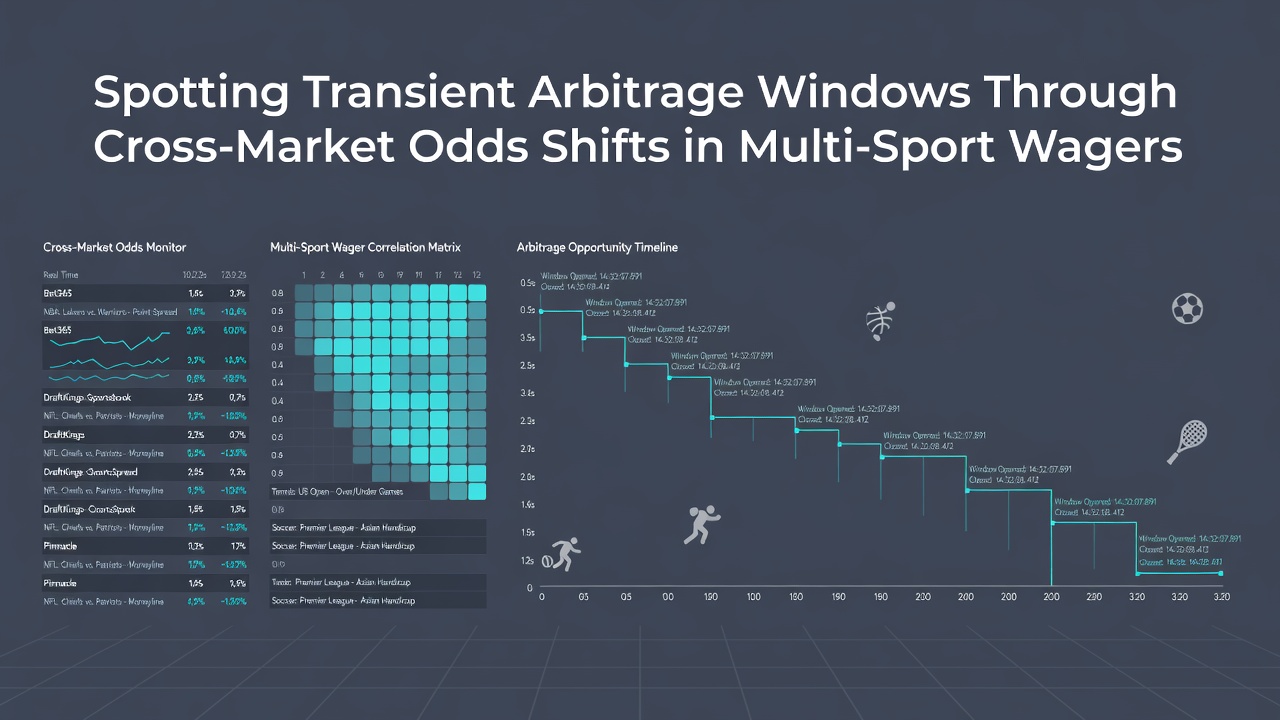
Specialized platforms aggregate live odds from dozens of sources and flag combinations whose aggregate implied probability falls below 100 percent. These alerts incorporate latency adjustments because data feeds from different jurisdictions update at slightly different intervals. Those who have studied the patterns emphasize that success depends on execution speed rather than on superior predictive skill, since the edge stems purely from price inconsistency rather than from any forecast of outcomes.
Settlement timing adds another layer. When one event finishes and the result is known, the remaining legs must still be placed or adjusted before the window closes. Operators that allow partial cash-outs or leg replacements sometimes extend the life of an arbitrage position, while stricter rules on same-game multis can truncate it. Regulatory filings from several Australian state authorities indicate that such product features influence the volume of detected arbitrage activity across their licensed markets.
Conclusion
Transient arbitrage windows arise when odds movements in one sport fail to synchronize with movements in another, producing brief intervals where multi-sport combinations carry a mathematical advantage. Documentation from multiple regulatory and academic sources confirms that these intervals occur with measurable frequency, particularly during periods of dense overlapping schedules such as those observed in October 2026. Market participants who deploy monitoring systems continue to capture these opportunities, though the windows remain short-lived and dependent on liquidity differentials across platforms and jurisdictions.